
ISO 13485 Explained in Plain English
24 March 2026
How an eQMS Simplifies ISO 13485 Compliance for UK Medical Device Startups
16 July 2026Why UK Medical Device Startups are Adopting eQMS to accelerate ISO 13485 Compliance
Bringing a new medical device to market is an exhilarating milestone for any UK tech startup. But as transition happens from a brilliant prototype to a commercialised product, you run head-first into a complex regulatory framework. In the UK, the path to market access requires strict adherence to international quality standards, chief among them being ISO 13485:2016.
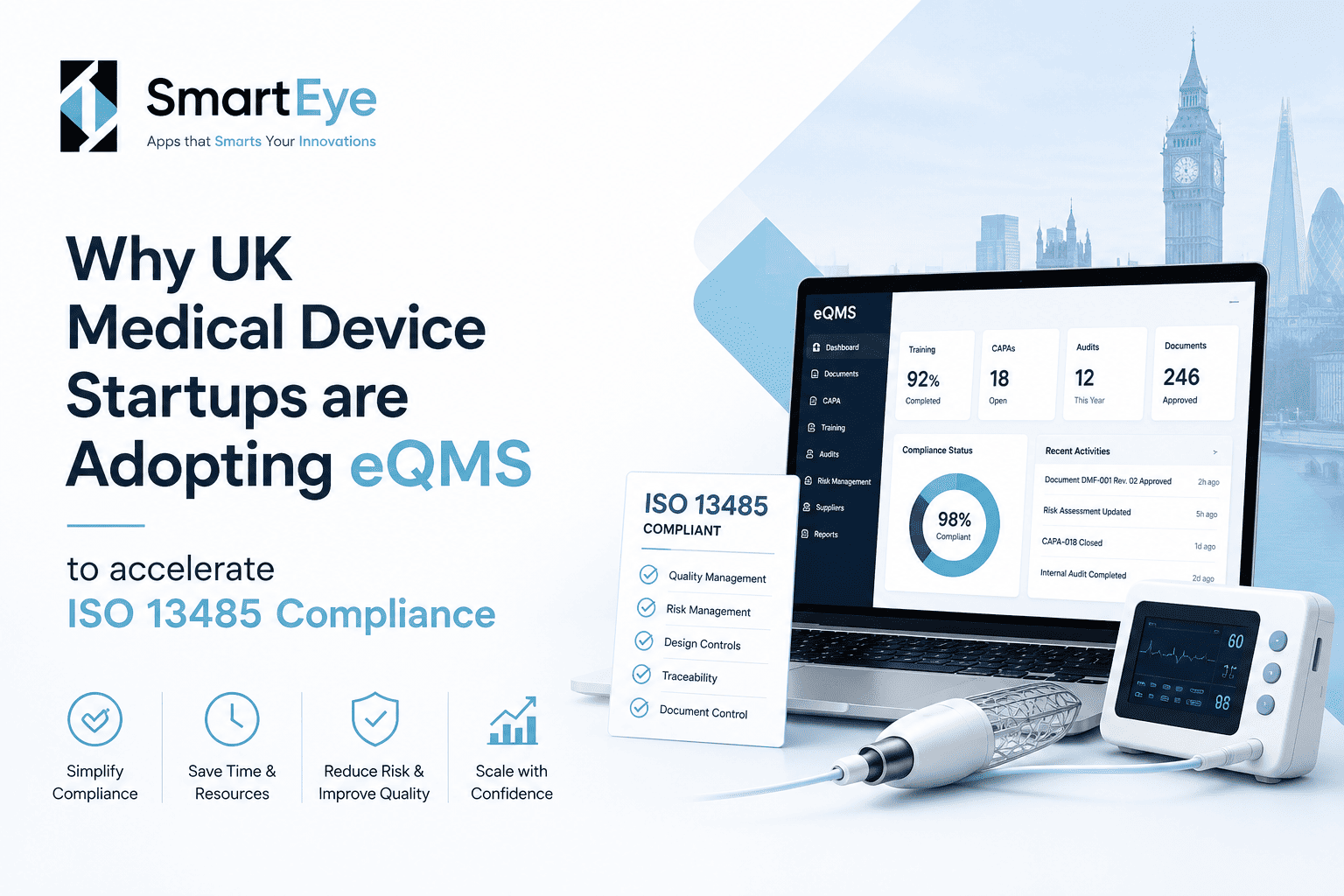
With the Medicines and Healthcare products Regulatory Agency (MHRA) updating its regulatory roadmap and rolling out pathways like the International Reliance Pathway, the compliance landscape is moving faster than ever. For agile startups, relying on legacy paper systems, scattered spreadsheets or basic cloud storage folders is no longer just inefficient, it is a major business risk.
This growing operational bottleneck is known as "document debt." Left unchecked, it can stall your regulatory submissions, inflate your audit prep costs, and delay your market launch by months. That is why a growing cohort of UK medtech innovators are bypassing traditional paperwork entirely and deploying an eQMS (electronic Quality Management System) right from day one.
How an eQMS Simplifies ISO 13485 Compliance
Although ISO 13485 certification is not legally mandatory in the UK, it is widely regarded as the foundation for demonstrating an effective Quality Management System when seeking UKCA marking under the UK Medical Devices Regulations (UK MDR). It also supports regulatory submissions in many international markets. Achieving certification requires proving to a UK Approved Body that you maintain complete control over your documentation, design changes, and risk management.
For software medical devices, an eQMS also supports compliance with IEC 62304 by providing traceability between software requirements, development activities, testing and release records.
Here is exactly how an eQMS replaces manual stress with automated compliance across the core clauses of the standard:
1. Centralising Document Control (Clause 4.2)
Under ISO 13485, every Standard Operating Procedure (SOP), work instruction and quality policy must undergo a rigorous lifecycle of drafting, review, approval and distribution.
The Executive Blueprint: Manual vs. Automated QMS
To see how this impacts your timeline to audit readiness, consider the structural difference in how data is handled:
| Regulatory Priority | Paper / General Cloud Drive | SmartEye eQMS Solution |
|---|---|---|
| Audit Preparation | Weeks of stressful manual file checks. | Zero-prep; real-time dashboard exports. |
| Sign-off Security | Scanned PDFs or physical ink. | Cryptographic, compliant e-signatures. |
| Traceability | Broken links across static files. | Automated, cross-linked entity database. |
| SOP Training | Email chains with "read and understood". | Automatic training prompts & quiz verification. |
Final Thoughts
FFor early-stage medical device companies, quality management should not be viewed as an administrative burden. A well-implemented electronic Quality Management System (eQMS) establishes the foundation for regulatory compliance, product quality and sustainable business growth.
As UK medical device regulations continue to evolve and documentation requirements become more demanding, organisations that digitise their Quality Management System early are better positioned to achieve ISO 13485 certification, prepare for audits with confidence and bring innovative products to market more efficiently.